
Photorealistic People with GPT Image 2.5: Flare vs Sunburst
Six tells from Reddit's biggest GPT Image 2.5 realism thread, turned into a checklist and scored on Flare and Sunburst, plus the reference-image method.
Last updated: 2026-09-13
The most-upvoted GPT Image 2.5 post on Reddit this week was a portrait with a single question: can you still tell? Two and a half thousand comments later, the answer was a ranked list of tells — and the top one, with almost seven thousand upvotes, was not a hand or an eye. It was an EXIT sign that was not centred over its door.
That thread is the best realism checklist anyone has written for this model. We turned it into six checks, wrote a prompt that deliberately bakes all six into one scene, and generated it on Flare and Sunburst.
The six-point tell check
Run this on every "photorealistic" output before you ship it:
- Sign and text placement. Signs sit where a building inspector would put them: EXIT directly above the door, switches beside frames, labels on the thing they label.
- Material continuity. A ceiling that starts as planks stays planks. Surfaces do not change material halfway across.
- Liquid levels. Every glass in frame agrees on which way is down.
- Light direction. Track lights and lamps point at something; shadows agree with the window.
- Hands. Four fingers and a thumb, and one knuckle fewer than most models want to draw.
- Spacing of repeated elements. Pendant lamps, bulbs, tiles and chairs are evenly spaced; two that sit unusually close together are the giveaway.
The test
high quality, 1024×1024, both models, one run each. The prompt names every element the checklist looks at:
A photorealistic candid photo of a woman in her late twenties sitting at a cafe table, both hands wrapped around a half-full glass of iced tea, looking slightly off-camera. Behind her: a wooden-plank ceiling with a row of evenly spaced pendant bulbs, a track light aimed at the wall, and a green EXIT sign mounted directly above a doorway. Natural window light from the right, shot on a 50mm lens, shallow depth of field.
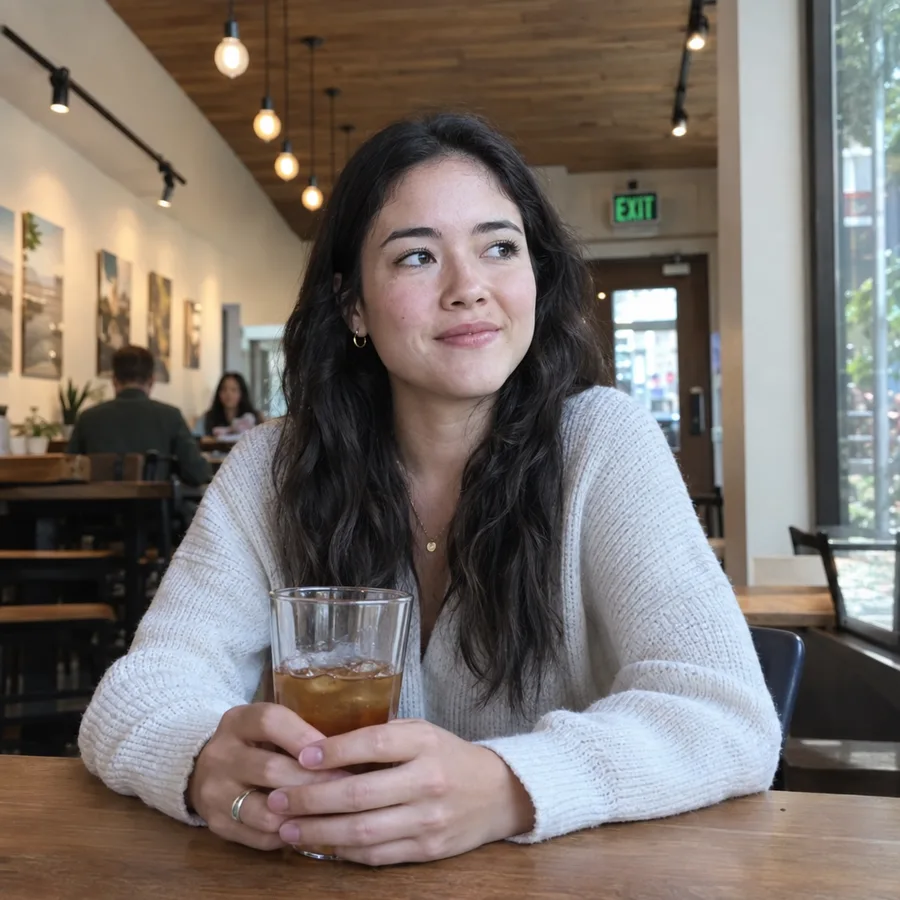
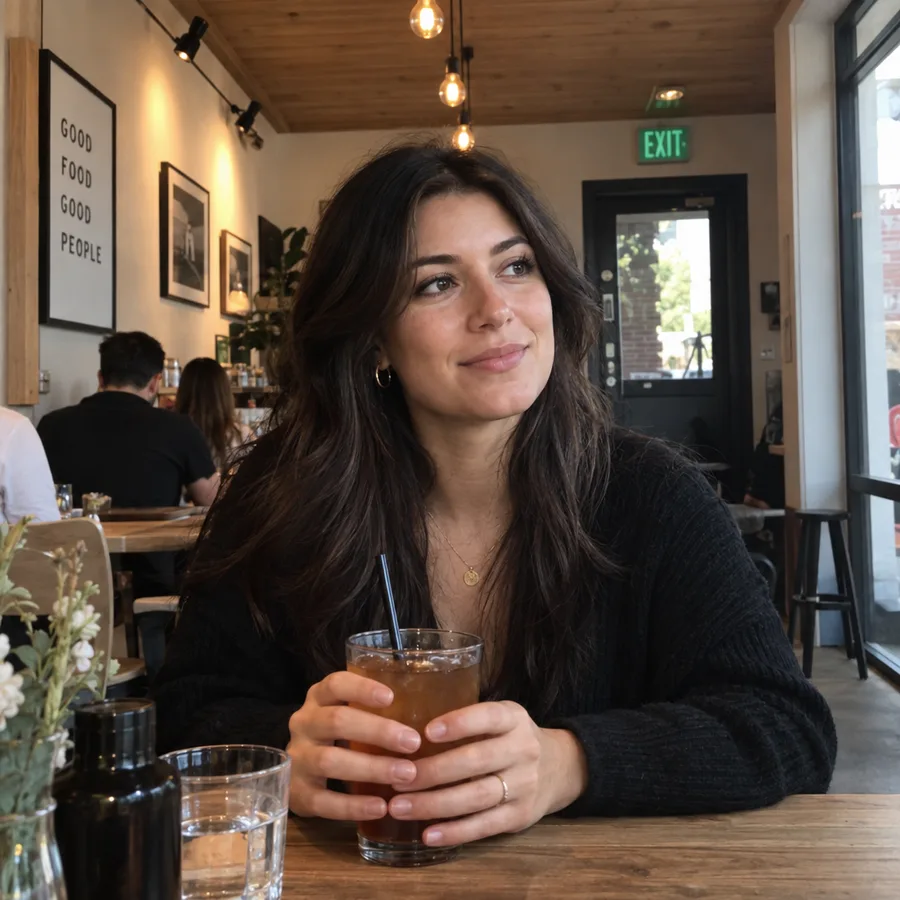
Flare: 20 s. Sunburst: 44 s. The same 1,756 output tokens, about $0.053 each at list price.
Scorecard
| Check | Flare (20 s) | Sunburst (44 s) |
|---|---|---|
| EXIT sign directly above the doorway | ✅ centred over the door | ❌ off to the side of the door |
| Ceiling material continuous | ✅ | ✅ |
| Liquid level horizontal | ✅ | ✅ (the second glass in the foreground too) |
| Light direction plausible | ✅ | ✅ |
| Hand anatomy | ✅ | ✅ |
| Pendant bulbs evenly spaced | ⚠️ uneven | ⚠️ uneven |
| Bonus: legible in-image text | — (abstract art on the wall) | ✅ a poster reads "GOOD FOOD GOOD PEOPLE" |
| Bonus: skin and hair detail | good | better |
The slower, "quality-optimised" model made the single most famous mistake in the thread, and the fast one did not. Sunburst still produced the more convincing person — finer skin texture, individual hair strands, and a poster you can read — which is exactly the trade you need to know about: Sunburst for the subject, a checklist for the scene, whichever model you use.
Neither model spaced the pendant bulbs evenly, even though the prompt asked. Repeated-element spacing looks like a shared weakness; check it every time.
Method: stop describing, start referencing
The other half of the realism recipe comes from X, where one creator put it bluntly: 2.5 is better than 2, but with no reference image it is still recognisably AI — stop describing the aesthetic and go steal it. That lines up with OpenAI's own prompting guidance, which for portraits comes down to:
- Say "photorealistic" or "real photograph" explicitly. The model does not default to it.
- Describe optics, not moods. "50mm, natural window light from the right, shallow depth of field, subtle grain" works. Whether "cinematic" on its own does anything is a single-source claim we have not tested yet — treat it as decoration, not an instruction.
- Give people a composition, a gaze and something to do with their hands. Our prompt wrapped both hands around a glass; both models rendered the hands cleanly.
- Use a reference photo for the look and assign it a role — "match the lighting and colour grading of image 1; the person and the room are new". That closes the last gap adjectives cannot.
- Fix tells with an edit, not a regeneration. "Move the EXIT sign so it is centred directly above the doorway. Keep everything else exactly as it is." Two sentences: the one change, then what must not move.
Which model
- Final portraits, product shots with people, anything with in-image text: Sunburst — then run the six checks and edit the misses.
- Casting, composition and lighting exploration: Flare — 20 s a round instead of 44, the same price, and it passed five of the six checks here.
- Both: at
highthey cost the same, so generating on both and picking is a 64-second, ten-cent experiment.
FAQ
Does Sunburst always produce more realistic people? It produced better skin, hair and text in our run — and misplaced a sign. "Better" is per check, not global. Score, don't assume.
Do I need max quality for realism?
Not for the tells above; every check in this test was run at high. Higher tiers add detail and cost — max is about 4× the tokens of high — but they do not fix scene logic.
Can I fix a tell without regenerating the whole image? Yes — that is what editing is for. State the one change and the list of things to keep; see the prompt rules.
Sources
- The "can you still tell?" thread on r/ChatGPT — the six tells are its highest-voted comments, rewritten as checks
- "Stop describing, use a reference" on X
- OpenAI image prompting guide
- Our run:
high, 1024×1024, 2026-09-12, one run per model; both images above are the unedited outputs.